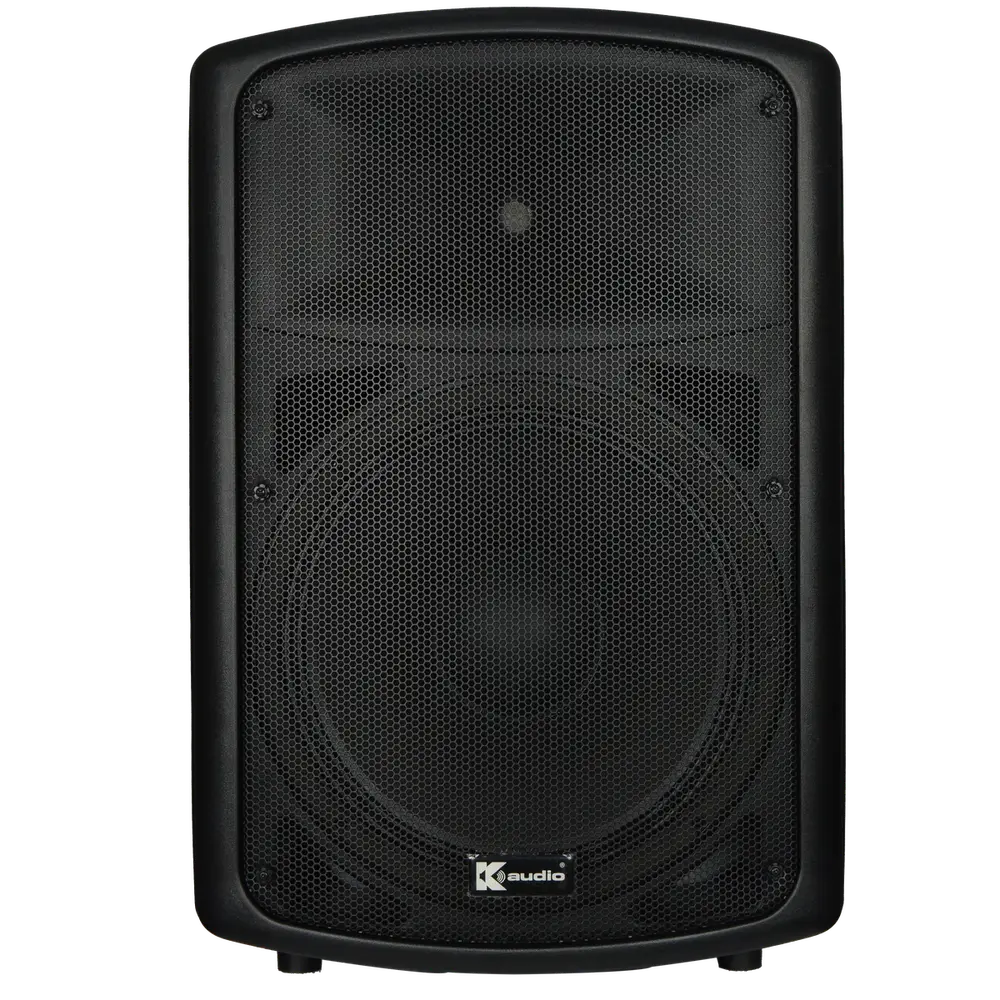
Choosing PA speakers is the single decision that shapes how your whole system sounds. Get it right and everything downstream becomes easier. Get it wrong and no amount of processing will rescue it. This guide walks through the decisions in the order they actually matter.
Match the speaker to the room first, then the amplifier to the speaker. For most venues: 10-inch for speech and monitors, 12-inch as the all-rounder, 15-inch where you need low-end weight without a subwoofer. Allow amplifier power of roughly 1.5 to 2 times the speaker's continuous rating.
Passive or active: decide this first
A passive speaker contains no amplifier. It needs an external power amplifier and speaker cable. An active (powered) speaker has amplification built in and takes a line-level signal.
Passive systems make sense when you are running multiple cabinets from a central rack, when amplifier access is easier than mains access at speaker positions, or when you want to standardise amplification across a venue. Most permanent installations are passive for this reason.
Active systems make sense for portable use, small setups and anywhere running mains to the speaker is simpler than running heavy speaker cable. Fewer boxes to carry, faster setup.
Match power ratings properly
The common mistake is buying an amplifier that is too small. An underpowered amplifier driven into clipping destroys more drivers than an oversized one ever will, because clipping sends sustained DC-like energy into the voice coil.
As a working rule, choose an amplifier that delivers roughly 1.5 to 2 times the speaker's continuous (RMS) power rating into the matching impedance. That gives you headroom for transients without running the amp at its limit.
Check impedance carefully. Two 8-ohm cabinets in parallel present 4 ohms. Four present 2 ohms, which many amplifiers cannot drive safely. Always confirm your amplifier's minimum stable impedance before wiring multiple cabinets per channel.
Woofer size sets the character
A 10-inch woofer is tight and articulate, easy to fly and ideal for speech, monitors and smaller rooms. A 12-inch is the versatile middle ground for most bands and mid-size halls. A 15-inch moves more air and gives you low-end weight without a subwoofer.
Bigger is not automatically better. A 15-inch cabinet in a small reverberant room often sounds worse than a 10-inch because the low end excites room modes you cannot control.
Coverage angle and placement
Coverage is quoted as horizontal x vertical, for example 90 x 60 degrees. Wide horizontal coverage suits shallow, wide rooms. Narrower coverage throws further down long rooms and reduces energy hitting side walls.
Aim to cover the audience and nothing else. Every degree of dispersion that lands on a wall or ceiling comes back as reflection and reduces intelligibility.
Match the speaker to the application
Speech-led applications such as conference rooms, schools and houses of worship reward tight controlled coverage and a mid-forward response. Music-led applications reward extended low frequency and higher SPL capability.
Weatherproof cabinets matter for any outdoor or semi-outdoor position. Standard cabinets will fail in those environments regardless of how they are covered.
| Woofer | Typical SPL | Best for | Typical audience |
|---|---|---|---|
| 10-inch | 124 dB | Speech, stage monitors, small rooms | Up to 100 |
| 12-inch | 127 dB | Bands, mid-size halls, worship | 100 to 250 |
| 15-inch | 129 dB | Music-led events, full-range without sub | 250 to 500 |
| Line array | 135 dB+ | Large venues, long throw, touring | 500+ |
Sensitivity and SPL: reading the spec sheet honestly
Sensitivity is measured in dB at 1 watt at 1 metre. A cabinet rated 98 dB produces 98 dB with a single watt. Add 3 dB every time you double power, so 100 watts into that cabinet gives roughly 118 dB at a metre.
Maximum SPL figures are often quoted at peak rather than continuous, and sometimes with the speaker driven into audible distortion. Treat quoted maximums as a ceiling you should not design to reach. Leave 6 dB of headroom below the quoted figure for anything you plan to run for hours.
Sensitivity matters more than raw power handling. A cabinet that is 3 dB more sensitive needs half the amplifier power to reach the same level, which saves money on amplification and reduces heat.
Frequency response and where the crossover sits
A quoted response of 50 Hz to 20 kHz means nothing without a tolerance. Look for a figure stated at plus or minus 3 dB. Without that tolerance, a manufacturer can quote a frequency that the cabinet reproduces at 15 dB down, which you will never hear.
For speech, response below 80 Hz adds little and can muddy intelligibility. For music, you want useful output to 50 Hz from the mains or a subwoofer covering below 80 Hz.
Crossover point matters for vocal clarity. A crossover placed in the 1.5 to 3 kHz region sits inside the range where the ear is most sensitive, so a poorly implemented crossover is audible on vocals.
Cabinet construction, rigging and practicalities
Plywood cabinets are heavier and more rigid, which suits installation. Moulded polypropylene is lighter and more impact resistant, which suits mobile use where cabinets get knocked.
Check for a pole socket if you plan to use speaker stands, and for M8 or M10 fly points if the cabinet will ever be suspended. Retrofitting rigging to a cabinet that was not designed for it is not safe.
Weight matters more than people expect. A 12-inch cabinet at 18 kg is a one-person lift. At 28 kg it becomes a two-person lift, which changes crew requirements for every event.