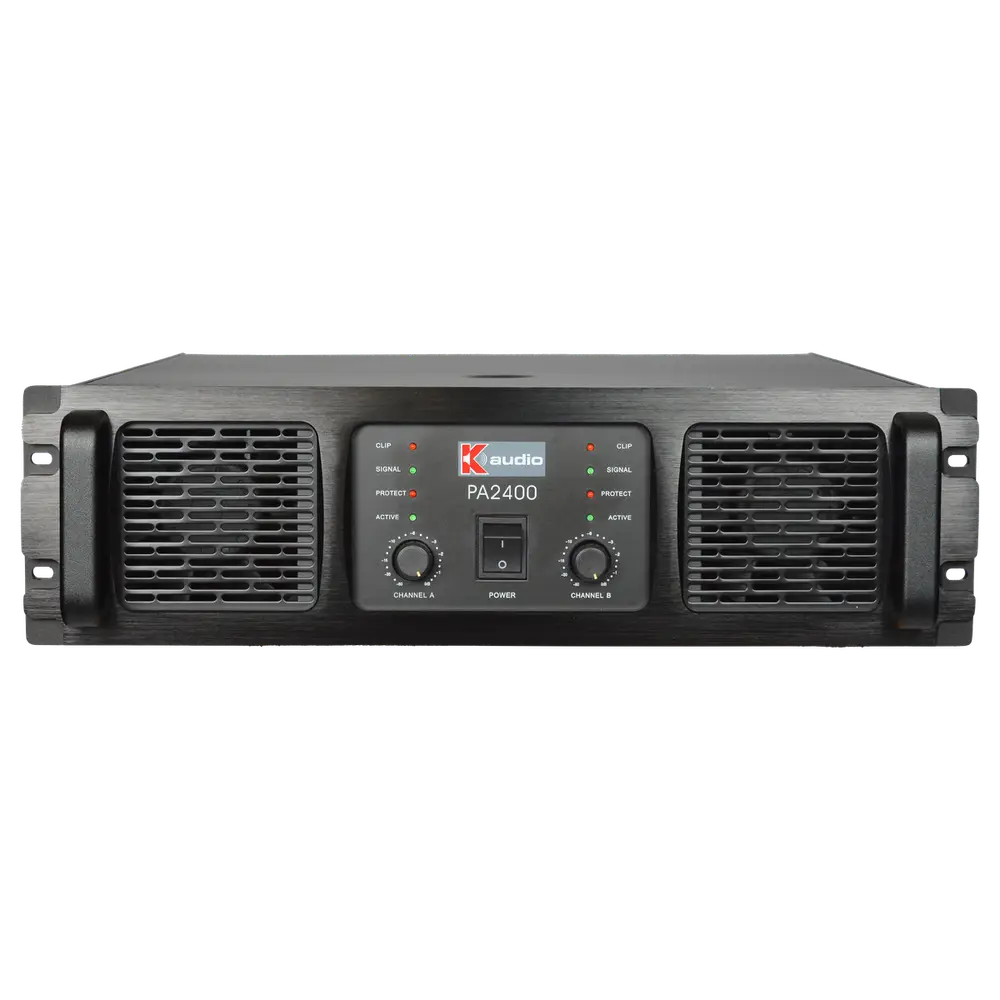
Amplifier specifications are where most PA purchases go wrong, because the headline wattage number tells you very little on its own. What matters is power at your actual impedance, with real headroom.
Size the amplifier at roughly 1.5 to 2 times the speaker's continuous power rating at the impedance you will actually run. Never run below the amplifier's minimum rated impedance, and always confirm continuous RMS figures rather than peak.
Read the power rating properly
Always work from continuous RMS power at a stated impedance, not peak or programme figures. An amplifier quoted at 1000 W peak may deliver 300 W continuous, and only the continuous figure predicts real behaviour.
Power roughly doubles as impedance halves, but only if the amplifier's power supply can sustain it. This is where cheap amplifiers fall down.
Impedance and how you wire it
Confirm the minimum impedance your amplifier is rated for. Running below it causes protection trips at best and failure at worst.
Two 8-ohm cabinets in parallel give 4 ohms. Series wiring gives 16 ohms and loses power. For distributed systems, 70V or 100V line removes the impedance problem entirely.
Headroom is what protects your drivers
Target roughly 1.5 to 2 times the speaker's continuous rating. That sounds like overkill and it is not. It means the amplifier never clips at working levels.
Clipping is the leading cause of driver failure. An amplifier that is too small kills speakers far more often than one that is too large.
Bridging and multi-channel amplifiers
Bridging combines two channels into one higher-power output, typically for a subwoofer. It doubles the effective impedance load on each half, so a bridged amp into 8 ohms behaves like each channel seeing 4.
Four-channel amplifiers make sense in installations where you drive several zones from one rack unit.
| Speaker continuous rating | Recommended amp power (per channel) | Typical use |
|---|---|---|
| 150 W at 8 ohms | 250 to 300 W at 8 ohms | Small hall, monitors |
| 300 W at 8 ohms | 450 to 600 W at 8 ohms | Mid-size hall, worship |
| 500 W at 8 ohms | 750 to 1000 W at 8 ohms | Large hall, live music |
| Subwoofer 600 W | 1000 to 1200 W bridged | Music-led events |
Damping factor and why cable gauge matters
Damping factor describes how well the amplifier controls driver movement after the signal stops. Higher is generally better for tight low frequency response.
Cable resistance sits in series with the speaker and reduces effective damping. Long runs of thin cable can undo the benefit of a high damping factor amplifier entirely.
For runs beyond about 15 metres at low impedance, step up the cable gauge. It costs little and preserves both power and control.
Protection circuits and what they tell you
Thermal protection, short-circuit protection and DC protection are standard. If they engage during normal operation, the system design is wrong, not the amplifier.
Repeated thermal shutdown usually means the load impedance is too low, ventilation is inadequate, or the amplifier is undersized for continuous operation at that level.
Treat a protection trip as a diagnostic signal. Resetting and continuing at the same level will eventually damage something.
Rack mounting, cooling and airflow
Amplifiers pull cool air in and exhaust hot air, usually front to back. Blocking either end causes thermal shutdown even when the amplifier is comfortably within its power rating.
Leave a rack unit of clearance above high-power amplifiers where possible, and never stack them directly against a rear panel.
In closed racks, add forced ventilation. In hot climates or plant rooms, derate expectations accordingly.