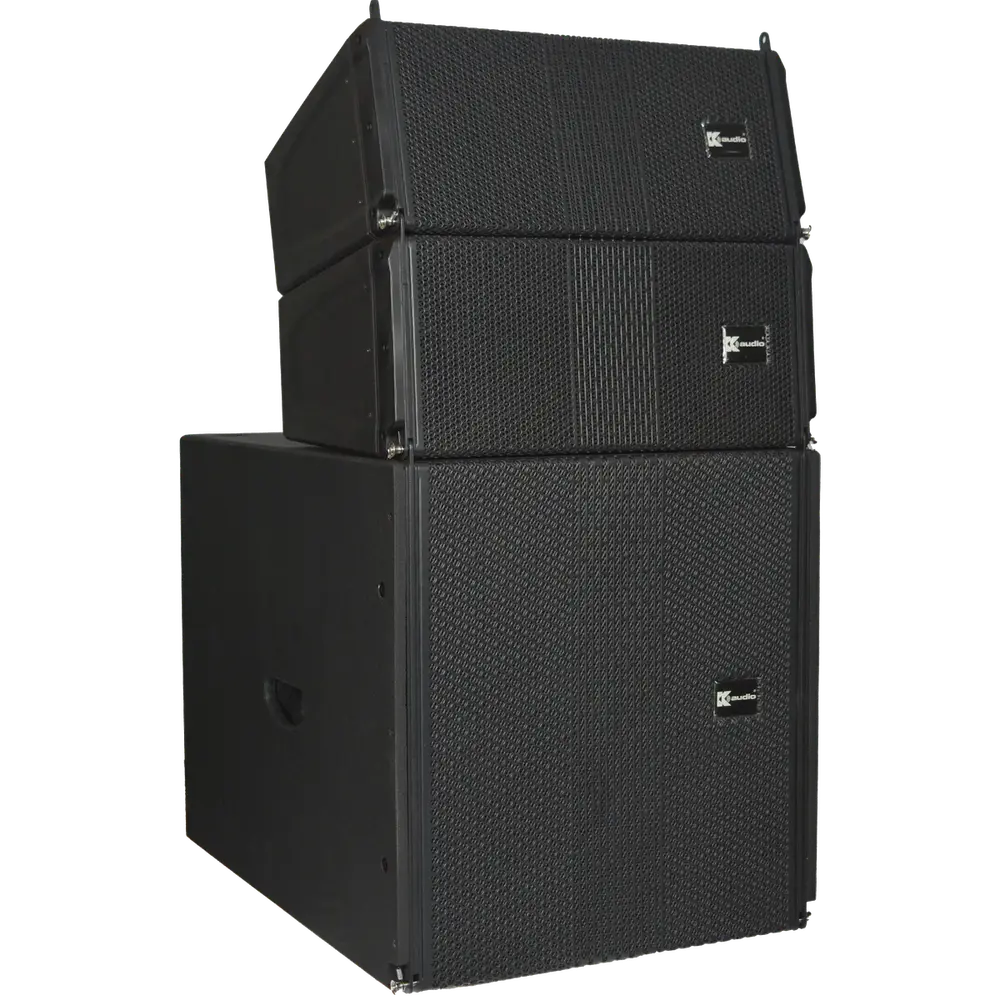
Line arrays are not simply better than point source speakers. They solve a specific problem, and if you do not have that problem you are paying for complexity you will never use. Here is how to tell which side you are on.
Choose a line array when throw distance exceeds roughly 25 metres or the audience is deeper than a point source can cover evenly. Below that, a quality point source pair costs far less, deploys faster and often sounds better.
What a line array actually does
Stack multiple identical drivers vertically and their outputs couple. Instead of sound falling off at 6 dB per doubling of distance as it does from a point source, a well-designed array approaches 3 dB per doubling through its near field.
In practice that means the front row and the back row hear a far more similar level. That is the entire point. It is a coverage-consistency tool, not a loudness tool.
When point source is the right answer
Rooms under roughly 20 metres deep. Audiences under a few hundred. Fixed installations where the speaker can be positioned close to the listeners. Budget-sensitive projects.
A pair of quality 12 or 15-inch cabinets on poles will outperform a badly deployed small line array every time, and cost a fraction as much.
When you genuinely need an array
Long throw distances beyond about 25 metres. Large or wide audiences. Reverberant rooms where controlling vertical dispersion keeps energy off the ceiling. Touring work where rigging speed and repeatability matter.
Arrays also let you shape vertical coverage by adjusting splay angles between elements, which point source cabinets cannot do.
The hidden costs of going array
Rigging hardware, certified flying points, more amplifier channels, processing and the labour to deploy it. An array is a system commitment, not a speaker purchase.
If you cannot fly it safely, you cannot use it properly. Ground-stacked arrays lose much of their advantage.
| Factor | Line array | Point source |
|---|---|---|
| Level falloff | About 3 dB per doubling in near field | 6 dB per doubling |
| Typical throw | 25 to 80 metres | Up to 25 metres |
| Setup time | Hours, needs rigging | Minutes, poles or ground stack |
| Relative cost | High, plus rigging and amps | Low to moderate |
| Best venue | Arenas, festivals, large worship | Clubs, halls, schools, conferences |
Splay angles and how coverage is actually shaped
The angle between each array element determines where energy goes. Tight splay at the top of the array throws far to the rear of the audience. Wider splay at the bottom covers the near field close to the stage.
This is why arrays are modelled in prediction software before deployment. Hanging elements at a uniform angle produces uneven coverage and wastes most of the array's advantage.
Getting splay wrong is the main reason a badly deployed array underperforms a simple point source pair. The hardware does not compensate for poor design.
Power, processing and the real system cost
Each array element needs amplifier channels and usually dedicated processing presets. A twelve-element system per side is a substantial amplifier rack, not a couple of channels.
Budget for the full chain: elements, subwoofers, amplification, processing, rigging hardware, cabling and the labour to fly it. The cabinets are often less than half the total.
Point source systems scale differently. Adding a delay speaker to extend coverage costs one cabinet and one amplifier channel.
Ground stacking and when it makes sense
Arrays can be ground stacked when flying is impossible, but you lose vertical control and the front rows take significantly more level than the rear.
If you cannot fly, a well-aimed point source system with delay positions usually delivers more even coverage than a ground-stacked array.