In hospitality, the sound system succeeds when nobody notices it. Even coverage at low level, no loud tables next to a speaker, no dead corners, and independent control per area.
Zone the venue, use many speakers at low level rather than few at high level, run 100V line for anything beyond a handful of speakers, and give outdoor areas weatherproof cabinets on their own zone.
Zone the venue first
Dining, bar, terrace and washrooms all want different levels. Treat each as a zone with its own volume control, driven from a multi-zone amplifier or separate amplifier channels.
This single decision prevents the most common complaint: the bar wants it loud, diners want it quiet.
More speakers, lower volume
Even coverage comes from many quiet sources, not a few loud ones. Guests should never be able to identify which speaker they are hearing.
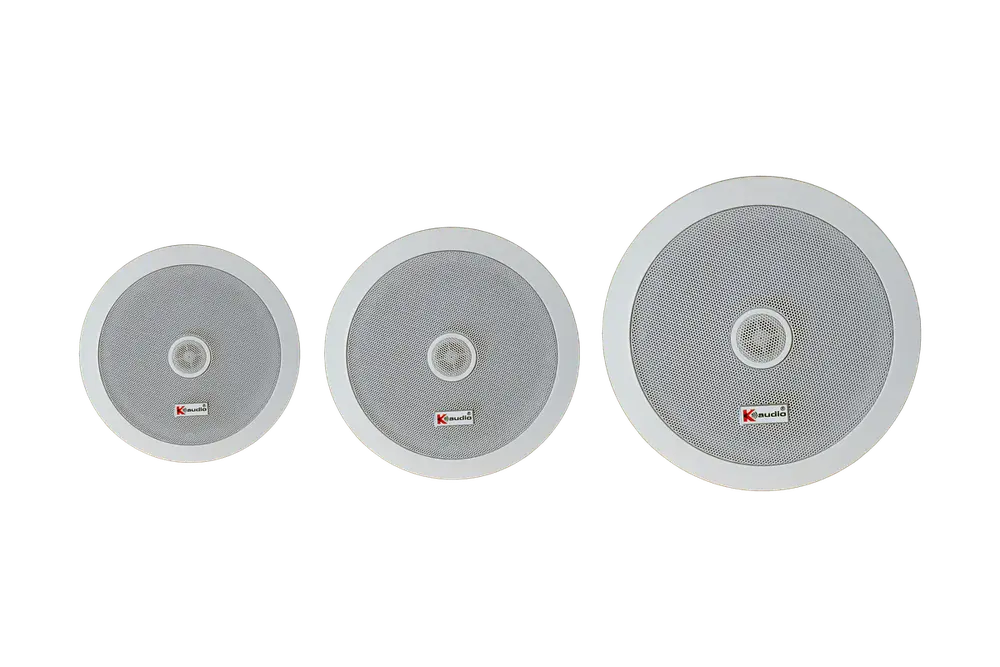
Ceiling speakers on a regular grid do this well. Aim for overlap so level barely changes as you walk through the room.
Use 100V line for anything beyond a few speakers
Constant-voltage distribution makes it trivial to run many speakers on long cable runs and set individual levels with transformer taps.
It also means adding a speaker later does not require recalculating the whole system.
Outdoor terraces need weatherproof cabinets
Standard speakers fail outdoors regardless of shelter. Moisture reaches the cone and the surround degrades.
Use weatherproof cabinets rated for the environment, and give the terrace its own zone since ambient noise there is higher.
| Zone | Typical level | Speaker type | Control |
|---|---|---|---|
| Dining | Low background | Ceiling, 6-inch | Fixed or staff dial |
| Bar | Moderate | Ceiling or surface | Staff dial |
| Terrace | Moderate | Weatherproof surface | Separate zone |
| Washrooms | Low | Ceiling, small | Fixed |
Managing level through the day
A venue that works at lunchtime is too quiet at 10pm. Ambient noise rises with occupancy, so background music must rise with it or it disappears.
Provide staff with a simple, limited-range control per zone rather than full access to the mixer. Set minimum and maximum limits so the system cannot be driven into distortion or turned off entirely.
Some venues automate this on a time schedule, which removes the decision from staff altogether.
Music sources, licensing and reliability
Commercial background music services provide licensed catalogues and scheduled playlists, which avoids the licensing exposure of using a consumer streaming account.
Whatever the source, it should be a fixed device in the rack rather than a member of staff's phone. Phones leave with their owners and connect inconsistently.
Provide an auxiliary input for events, but keep it separate from the default source so normal service is never disrupted.
Speech intelligibility for announcements
If the venue makes announcements or has a paging requirement, specify a microphone input with priority that ducks the music automatically.
Place the paging microphone where staff actually stand, typically the host station or bar, not in a back office.