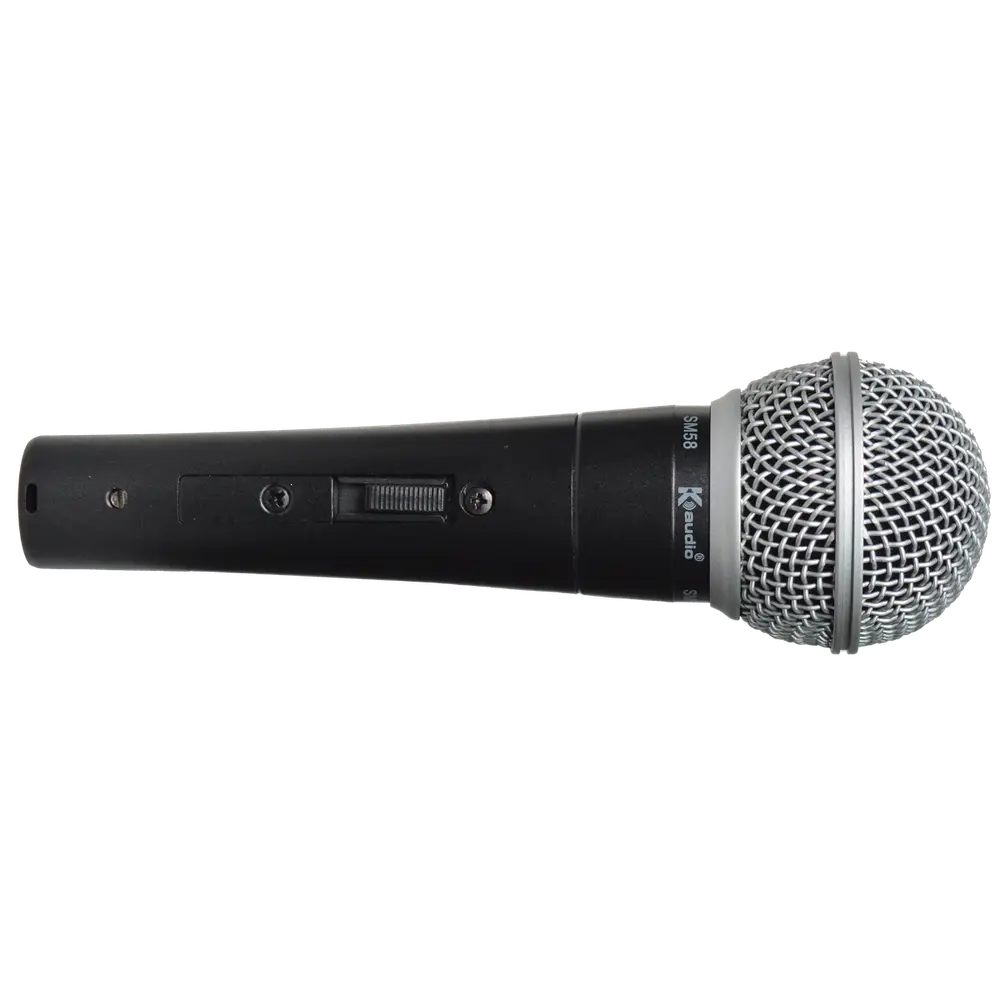
Feedback happens when a microphone hears its own amplified output and the loop gain reaches unity. Every fix below either breaks that loop or reduces its gain. Work through them in order, because the early ones cost nothing.
Move speakers in front of the microphone line, get microphones closer to the source, use directional patterns aimed away from speakers, ring out with narrow EQ cuts, and mute unused channels.
Move the speakers, not the EQ
The single most effective fix is physical. Get the speakers in front of the microphone plane and angled away from it. Feedback frequently disappears entirely with a metre of repositioning.
If mains have to sit near microphones, tighten their coverage or move to a distributed layout with more, quieter sources rather than fewer, louder ones.
Get the microphone closer to the source
Doubling the distance from mouth to microphone costs you 6 dB of signal, which you then have to make up with gain that also amplifies the room. Close miking is free gain-before-feedback.
This is why headset microphones are so much more resistant to feedback than a lectern microphone at arm's length.
Use directional microphones properly
A cardioid microphone rejects sound from directly behind it. A supercardioid rejects best at roughly 125 degrees off-axis but has a small rear lobe. Aim the null at the speaker.
Omnidirectional microphones have no rejection and are the hardest to control in a live system.
Ring out the system with a graphic EQ
Raise the master slowly until the first ring appears, cut that frequency narrowly by 3 to 6 dB, and repeat a few times. Stop after three or four cuts.
Over-ringing destroys tone. The goal is a few dB more headroom, not a system that cannot feed back at any volume.
Fix gain structure and mute what you are not using
Open microphones add up. Four open channels have roughly 6 dB less feedback margin than one. Mute anything not in use, and use a gate on lecterns where practical.
Also check you are not boosting low mids on multiple channels, which is a common hidden cause.
| Fix | Effort | Typical gain improvement |
|---|---|---|
| Reposition speakers | Low | 6 to 10 dB |
| Halve mic-to-source distance | Low | 6 dB |
| Correct microphone pattern | Low | 3 to 6 dB |
| Ring out with graphic EQ | Medium | 3 to 6 dB |
| Mute unused channels | Low | 3 dB per halving |
Why gain before feedback is the number that matters
Gain before feedback is how much level you can achieve before the system rings. It is determined by the acoustic relationship between speakers, microphones and the room, not by equipment quality.
Every doubling of open microphones costs roughly 3 dB of gain before feedback. A system with eight open microphones has 9 dB less margin than one with a single open microphone.
This is why automatic microphone mixers exist in conference systems. They open only the microphones being used and keep the rest closed.
Room acoustics and reflections
A reflective room returns energy to the microphone from surfaces as well as directly from the speakers. Hard parallel walls create the worst case.
Absorption at first reflection points reduces feedback risk as well as improving clarity. In many rooms this is more effective than any electronic solution.
Low ceilings above the microphone position are a common overlooked reflector, particularly in school halls and meeting rooms.
Notch filters versus graphic EQ
A graphic EQ cuts a fixed band, typically one third of an octave, which removes more of the signal than necessary. A parametric notch filter can be far narrower and more surgical.
For permanent installations, parametric filters preserve tone better. For portable systems, a graphic EQ is faster to operate under pressure.
Either way, three or four cuts is the practical limit. Beyond that you are damaging the sound to solve a placement problem.