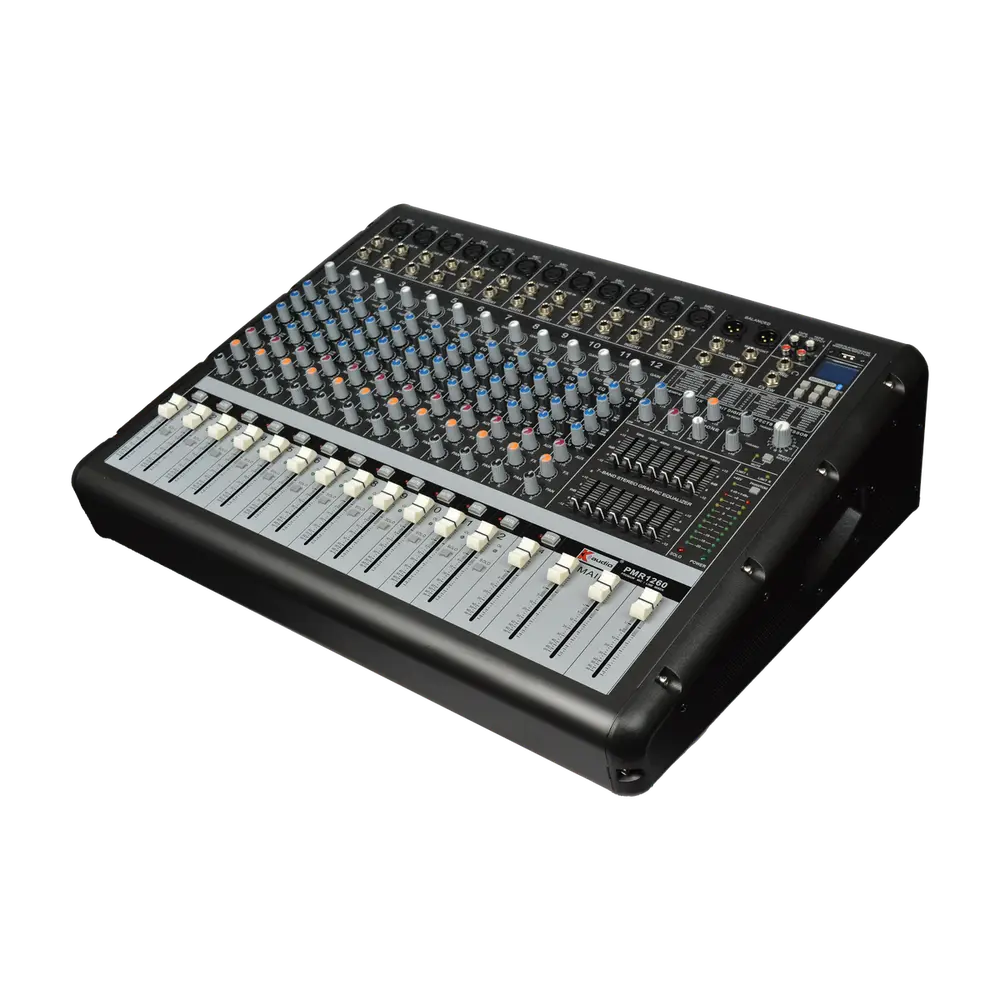
A powered mixer combines console and amplifier in one chassis. It is the fastest route to sound for small venues and mobile work, but it caps how far your system can grow. Here is the trade-off in practical terms.
Choose a powered mixer for portable use, small venues and volunteer-operated systems where speed and simplicity matter most. Choose separates when the system needs to grow, cover multiple zones, or be serviced without losing the whole desk.
The case for a powered mixer
One box, one mains lead, one thing to carry. For a house of worship with a volunteer running sound, or a mobile setup that gets packed away weekly, that simplicity is worth a great deal.
You also remove a whole class of setup errors: no gain-staging mismatch between console output and amplifier input, no wrong cable, no forgotten amplifier rack.
The case for separate components
Flexibility. You can upgrade the console without replacing amplification, add channels, run more zones or change amplifier power as the venue grows.
Repairability matters too. When a powered mixer's amp section fails, the whole desk goes out of service. With separates, you swap one component.
Match the power to the room
A 400 to 600 watt powered mixer suits a small hall or meeting room. Around 800 to 1200 watts covers a mid-size church or school hall. Beyond that, separates almost always make more sense.
Remember that quoted power is usually total across channels, not per channel. Check the specification at your actual load impedance.
Channel count and features
Count your sources and add at least four spare channels. Systems always grow. Also check how many aux sends you get, since monitor mixes and effects both consume them.
Built-in DSP effects and a graphic EQ on the output are genuinely useful on a powered mixer, because they remove the need for extra outboard.
| Venue | Approx capacity | Suggested power | Channels |
|---|---|---|---|
| Meeting room, small chapel | Up to 80 | 300 to 400 W | 6 to 8 |
| School hall, mid church | 80 to 250 | 600 to 800 W | 10 to 12 |
| Large hall, main sanctuary | 250 to 500 | 1000 to 1600 W | 14 to 16 |
| Beyond 500 | 500+ | Use separates | 16+ |
Aux sends, monitors and effects
Every monitor mix consumes one aux send, and so does an outboard effect. A mixer with two auxes gives you one monitor mix and one effects send, which is the practical minimum for a band.
Check whether auxes are pre-fader or post-fader, and whether that is switchable. Monitor sends must be pre-fader, otherwise the performers' monitor level changes every time you move a channel fader.
Built-in DSP effects save rack space and setup time. A reverb and a delay cover the majority of live requirements for speech and small music groups.
Inputs, connectors and what you actually plug in
Count XLR microphone inputs separately from line inputs. Many mixers quote a total channel count that includes stereo line channels usable only for playback.
Phantom power is required for condenser microphones. Check whether it is global across all channels or switchable per channel; global phantom can cause problems with some ribbon microphones and unbalanced sources.
Look for a dedicated playback input on RCA or 3.5 mm, and a USB or Bluetooth input if background music comes from a phone or laptop.
Reliability, cooling and service considerations
Powered mixers put amplification and low-level electronics in one chassis, which means heat sits close to sensitive circuitry. Ensure ventilation is unobstructed and never operate one inside a closed cabinet.
For installations that must not fail, separates give redundancy. A spare amplifier is cheap insurance; a spare powered mixer is not.