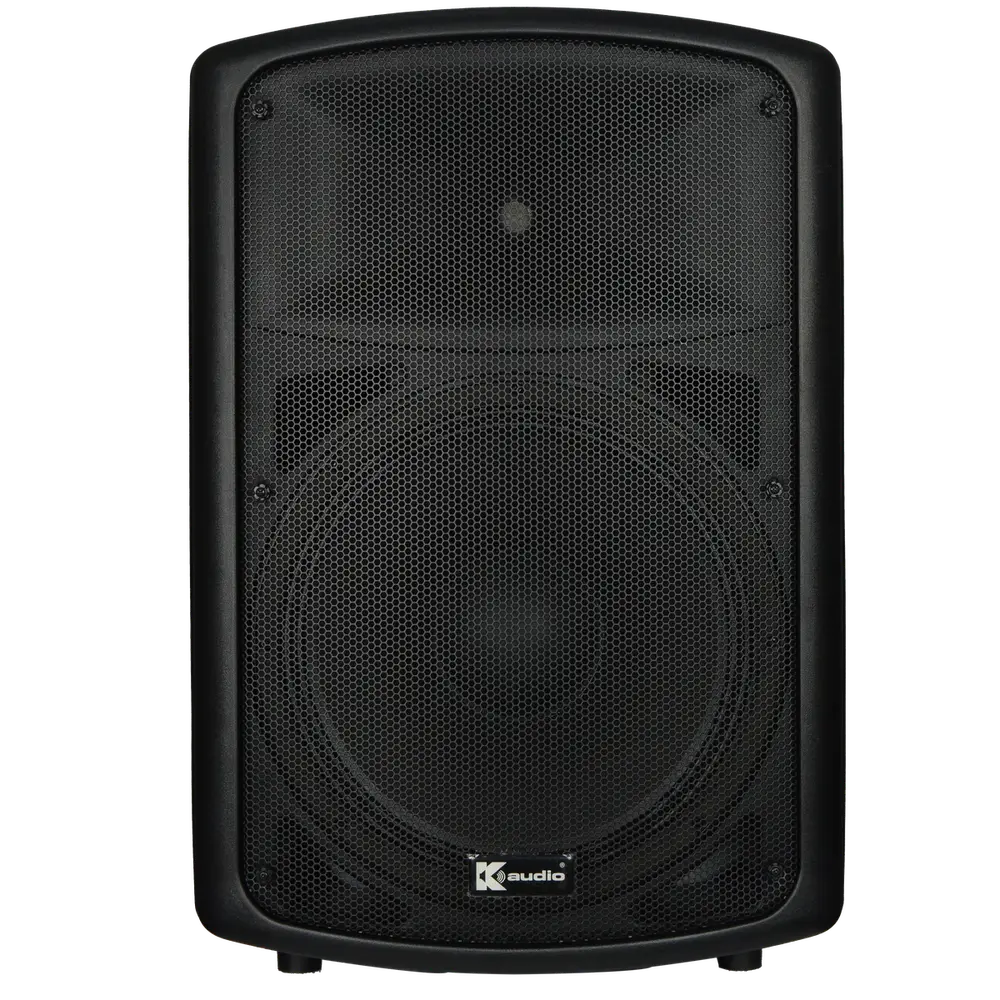
Subwoofers are the part of a system most often installed incorrectly, because low frequencies interact with rooms in ways that are invisible until you listen. Placement and alignment matter far more than the specification of the box.
Cross over around 80 to 100 Hz, high-pass the mains at the same point, check polarity, then time-align the subwoofer to the mains. Placement against a wall increases output; corner placement increases it further but excites room modes.
| Position | Output gain | Trade-off |
|---|---|---|
| Free standing | Reference | Least output, most even |
| Against one wall | About +3 dB | Slight boom |
| Wall and floor junction | About +6 dB | Noticeable emphasis |
| Corner | Up to +9 dB | Strong room mode excitation |
| Centre cluster | Even coverage | Requires space at front |
Choosing the crossover point
For most systems, 80 to 100 Hz works well. Below 80 Hz the mains often struggle; above 100 Hz the subwoofer becomes locatable, which breaks the illusion that sound comes from the stage.
Always high-pass the main speakers at the same frequency you low-pass the subwoofer. Running the mains full range alongside a subwoofer causes overlap, cancellation and wasted power.
Steeper crossover slopes reduce overlap but can introduce phase shift around the crossover point, which is why alignment matters.
Polarity and phase alignment
Check polarity first. A subwoofer wired out of polarity with the mains produces cancellation exactly where you need the most output, and the symptom is a thin sound that gets worse when the subwoofer is turned up.
Once polarity is correct, align timing. The subwoofer and mains are rarely the same distance from the audience, so a delay on one of them is usually needed.
The practical test is simple: play material with strong content around the crossover frequency and adjust until the transition sounds fullest, then verify at several positions in the room.
Single, stereo or centre cluster
Low frequencies are largely non-directional, so stereo subwoofers rarely provide a stereo image. What they do provide is more output and sometimes more even coverage.
Two subwoofers spaced apart can create a cancellation zone in the centre of the room at certain frequencies. A centre cluster avoids this and gives the most even coverage.
In smaller venues a single well-placed subwoofer usually outperforms two poorly placed ones.
Room modes and why one seat sounds different
Every room has resonant frequencies determined by its dimensions. At those frequencies, some positions have excess energy and others have almost none.
This is why the low end can sound overwhelming at the mixing position and absent twenty rows back. It is a room behaviour, not a system fault.
Moving the subwoofer even a metre can substantially change which positions are affected. Always walk the room before finalising placement.