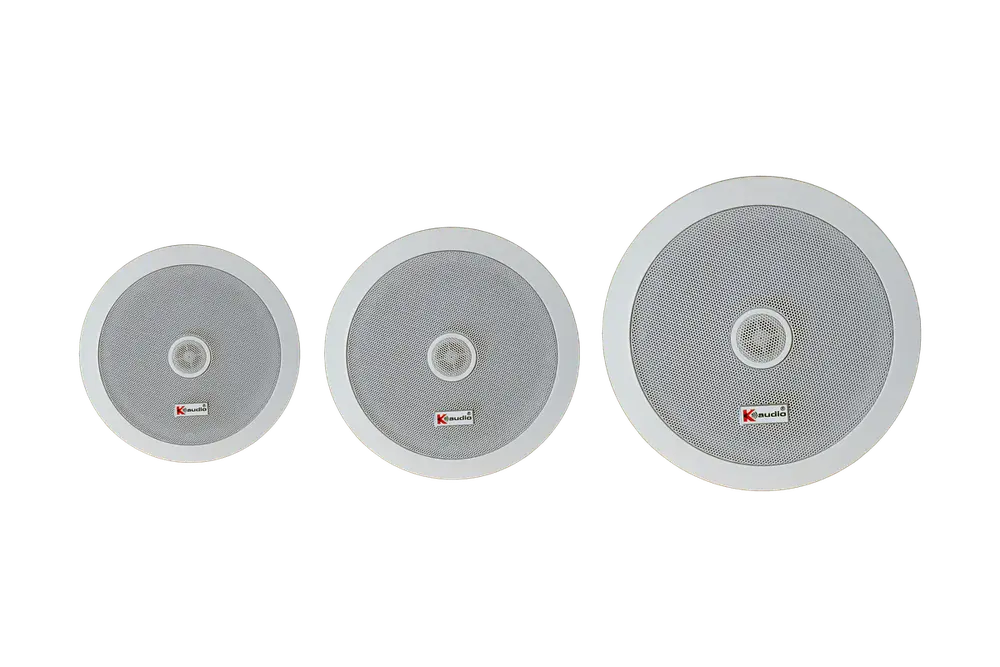
For background music and paging, this choice determines whether coverage sounds even or patchy. It comes down to ceiling height, what the space is used for, and whether you need music quality or just intelligible speech.
Use ceiling speakers for even background music and paging in rooms under about 5 metres high. Use wall-mount where ceilings are high, the audience faces one direction, or the ceiling cannot be cut into.
How ceiling speakers cover a room
Ceiling speakers fire downward in a cone. Coverage diameter is roughly equal to the height above listener ears multiplied by a factor set by the speaker's dispersion angle.
That means more speakers at lower volume, which is exactly what you want for even background music. Nobody sits directly under a loud source.
Where wall-mount is the better answer
High ceilings, exposed services, or heritage buildings where you cannot cut into the ceiling. Also any space where the audience faces one direction, such as a hall or chapel.
Wall-mount cabinets throw horizontally across a room and generally give better speech intelligibility in halls than ceiling speakers do.
Ceiling height changes everything
Under about 3 metres, ceiling speakers work well and spacing is generous. Between 3 and 5 metres you need more units or wider dispersion models.
Above roughly 6 metres, ceiling speakers become inefficient. Wall-mount or pendant designs usually make more sense.
Cost, aesthetics and serviceability
Ceiling speakers disappear visually, which clients like, but installation is more invasive and servicing means access above the ceiling.
Wall-mount is quicker to install, easier to service and easier to re-aim later if the room use changes.
| Ceiling height | Height above ear level | Typical spacing | Coverage per speaker |
|---|---|---|---|
| 2.7 m | 1.5 m | 2 to 3 m | 6 to 9 sq m |
| 3.5 m | 2.3 m | 3 to 4 m | 10 to 16 sq m |
| 4.5 m | 3.3 m | 4 to 5 m | 16 to 25 sq m |
| 6 m+ | 4.8 m+ | Consider wall-mount or pendant | - |
Dispersion angle and overlap
Most ceiling speakers have a nominal dispersion of 90 to 120 degrees at higher frequencies, narrowing with frequency. Wider dispersion allows greater spacing.
For even background music, aim for edge-to-edge overlap so level varies by no more than 3 dB as you walk between speakers.
For paging only, you can space more widely and accept greater variation, which reduces speaker count and cost.
Fire rating, back cans and building regulations
Ceiling speakers in a fire-rated ceiling usually require a fire hood or back can to maintain the rating. This is a building regulation issue, not an audio one.
Back cans also improve low frequency response by controlling the rear volume, and reduce sound transmission into the space above.
In plenum ceilings, check whether plenum-rated cable is required in your jurisdiction.
Aesthetics and specification in finished spaces
Ceiling speakers can be painted to match in most cases, provided the grille is not clogged. Confirm with the manufacturer before painting.
In heritage or glass-ceilinged buildings, surface-mount and pendant designs avoid cutting into the structure entirely.
Wall-mount cabinets on swivel brackets can be re-aimed later, which is valuable in spaces whose layout changes.