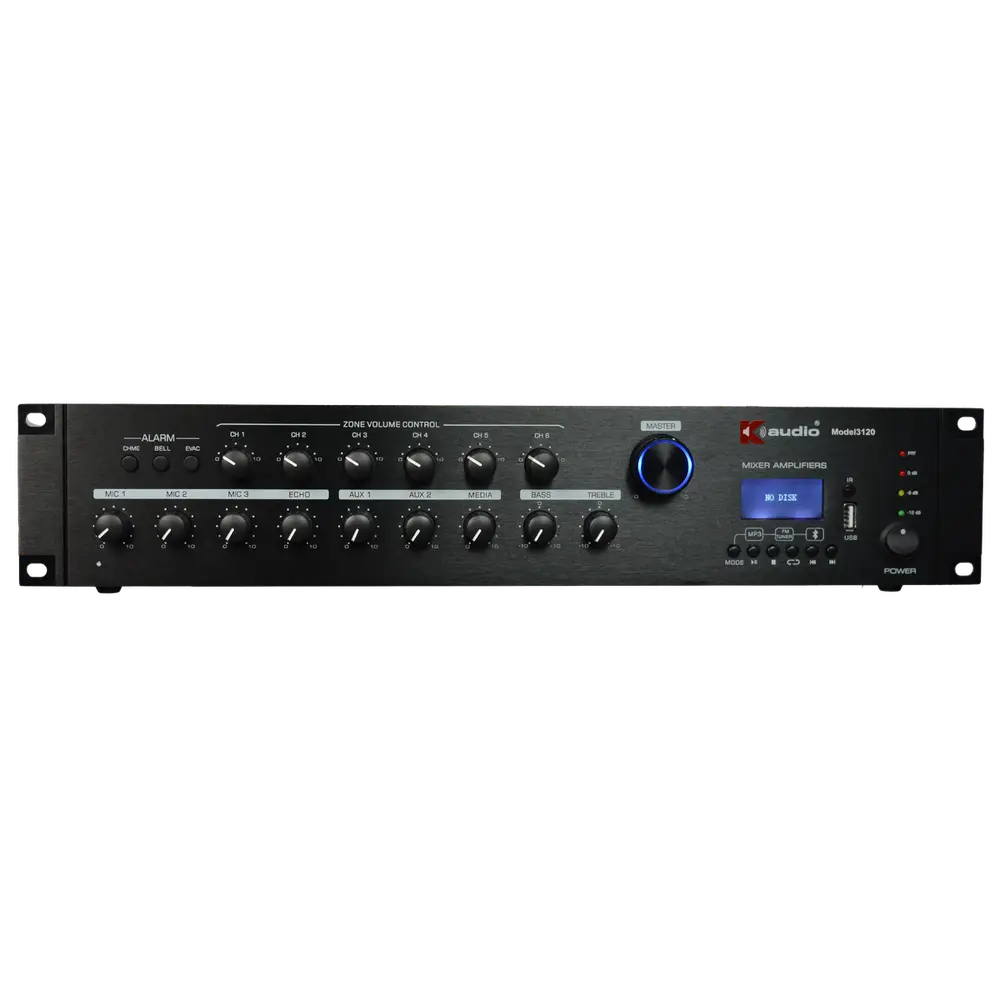
Constant-voltage distribution is what makes large commercial audio practical. It removes impedance arithmetic, allows very long cable runs and lets you set each speaker's volume with a screwdriver instead of a calculator.
Set each speaker's wattage tap, add the taps together, then choose an amplifier rated at least 20 percent above that total. Constant voltage suits paging and background music over long runs, not high-fidelity music reproduction.
Why constant voltage exists
In a low-impedance system, every speaker you add changes the load the amplifier sees. Get it wrong and you damage the amplifier.
In a 70V or 100V system, a transformer at each speaker steps the high-voltage signal down. You simply add up the wattage taps and keep the total below the amplifier rating.
How to calculate the load
Decide each speaker's tap: a corridor speaker might be 3 W, a retail floor speaker 10 W, a noisy warehouse 30 W.
Add every tap together. Then choose an amplifier rated at least 20 percent above that total, so it is not running flat out continuously.
Cable runs and why voltage matters
Higher voltage means lower current for the same power, and lower current means less loss in the cable. This is why 100V line can run hundreds of metres on modest cable.
For long runs, still step up the cable gauge. Losses accumulate and show up as reduced level at the far end of the run.
When not to use it
Transformers roll off low frequencies, so full-range music reproduction and any high-fidelity application is better served by low-impedance.
Use constant voltage for paging, background music and distributed speech. Use low-impedance for main PA, stage and performance systems.
| Space | Ambient noise | Typical tap | Speakers per 100 sq m |
|---|---|---|---|
| Office, corridor | Low | 1.5 to 3 W | 4 to 6 |
| Retail floor | Moderate | 6 to 10 W | 4 to 6 |
| Restaurant, bar | Moderate to high | 10 W | 5 to 7 |
| Warehouse, factory | High | 15 to 30 W | 2 to 4 |
Transformer taps and how they work
The transformer at each speaker steps the 100V line down to what the driver needs. Selecting a lower tap draws less power and produces less level.
Taps are typically switch or wire selectable on the speaker. Setting them correctly during commissioning is how you balance level across zones without additional electronics.
Always confirm the tap after installation. Speakers frequently ship on a default tap that does not match the design.
Insertion loss and low frequency limits
Transformers introduce a small insertion loss, typically 0.5 to 1.5 dB, and they roll off low frequencies. This is why constant-voltage systems sound lighter than low-impedance equivalents.
For paging and background music this is irrelevant and sometimes helpful, since less low frequency means less muddiness in reverberant spaces.
For music-led venues, use low-impedance for the main system and constant voltage only for peripheral areas.
Zoning, paging priority and system design
Constant-voltage systems make zoning straightforward. Each zone gets its own amplifier channel or an attenuator, allowing independent level control.
Paging systems need priority override so announcements mute background music. Specify this at design stage; retrofitting priority is awkward.
Use 100V-rated attenuators with priority relay if you need local volume control that a paging announcement can override.