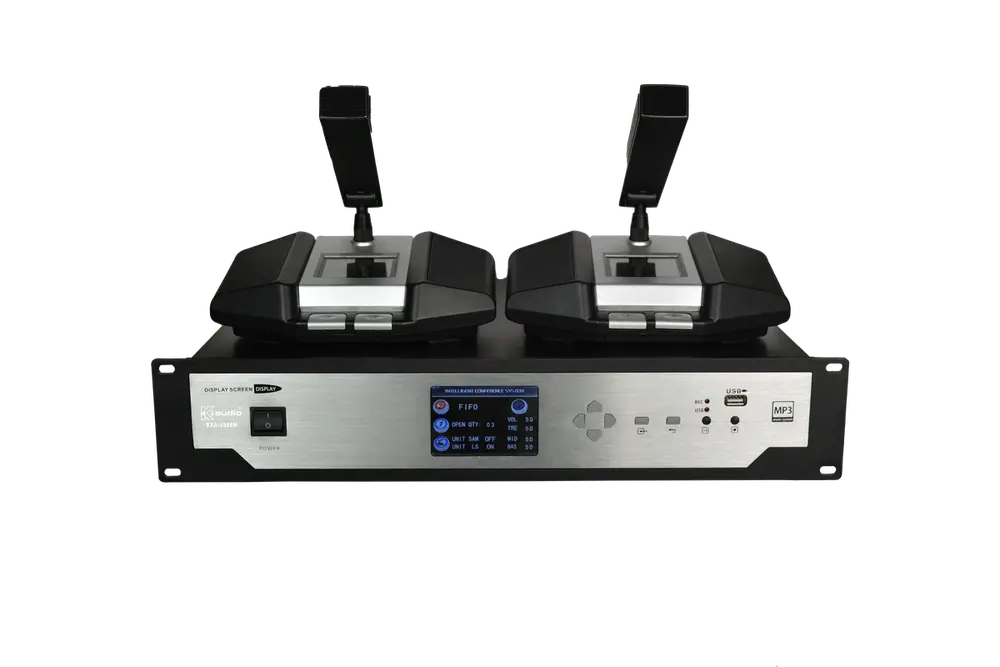
Conference audio is judged on one thing: can the remote participants hear clearly. Everything else is secondary. That means microphone coverage and echo control matter far more than speaker specifications.
Plan one microphone per one to two seats, keep loudspeakers out of microphone pickup patterns, give the chairman priority and mute control, and test with a real remote call rather than listening in the room.
Microphone coverage sets the ceiling on quality
Every seat that speaks needs a microphone within roughly half a metre. Beyond that, the room is louder than the talker and remote listeners struggle.
Discrete delegate units on the table are the reliable approach for boardrooms and council chambers, with a chairman unit that has priority.
Chairman priority and delegate control
A chairman unit that can mute all delegates keeps large meetings orderly and prevents multiple open microphones raising the noise floor.
Limiting how many delegate microphones can be open simultaneously improves intelligibility measurably.
Speaker placement to avoid echo
Keep loudspeakers away from microphones and out of their pickup pattern. Ceiling speakers directly above the table are a common cause of remote echo.
Lower level from more speakers is better than high level from few. It reduces what the microphones pick up.
Room treatment and glass
Modern boardrooms are glass, plaster and hard tables. All of it reflects. A rug, fabric panels or acoustic ceiling tiles improve calls more than any equipment change.
Test with a real remote call, not by listening in the room. The room always sounds better than the far end.
| Room size | Seats | Microphone approach | Speakers |
|---|---|---|---|
| Small | 4 to 8 | Boundary or 2 to 4 delegate units | 2 to 4 ceiling |
| Medium | 8 to 20 | Delegate unit per 2 seats | 4 to 8 ceiling |
| Large | 20 to 50 | Delegate unit per seat, chairman unit | 8 to 16 ceiling or distributed |
| Chamber | 50+ | Full conference system with control | Zoned distributed |
Acoustic echo and why it happens
Echo on the far end occurs when loudspeaker output re-enters the microphones and is sent back down the line. Acoustic echo cancellation reduces this but cannot fix a badly laid out room.
Reducing loudspeaker level and increasing the number of speakers lowers what each microphone picks up, which improves cancellation performance.
Hard tables reflect speaker output straight into table microphones. A table surface with some absorption, or ceiling speakers positioned away from the table, both help.
Automatic microphone mixing
An automatic mixer opens only the microphones currently being spoken into and attenuates the rest. This raises gain before feedback and lowers the noise floor considerably.
In rooms with more than about eight microphones, automatic mixing is close to essential.
Set a maximum number of open microphones. Four is a common and effective limit even in large rooms.
Integration with video conferencing platforms
Most modern conference systems provide a USB or Dante output for connection to a video platform. Confirm which the room's video system expects before specifying.
Keep the audio path as short as possible. Every additional conversion adds latency, and latency above about 150 milliseconds disrupts natural conversation.
Test with the actual platform the organisation uses. Behaviour differs between platforms, particularly in how each handles echo cancellation.