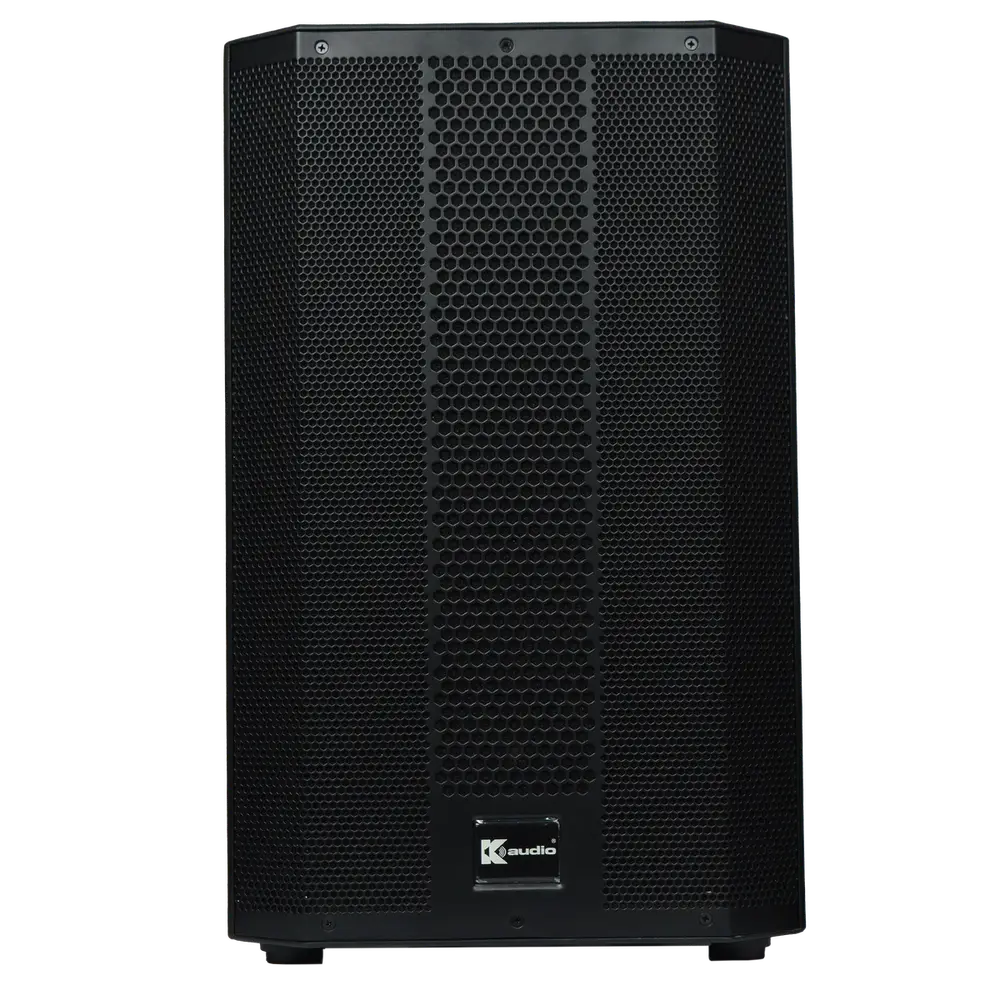
This is the first fork in any PA purchase, and it shapes cost, cabling and how the system grows. Neither is better in the abstract. What matters is where power is easy to run and how the system will be used.
Active suits portable use and small setups where mains power is already at the speaker position. Passive suits permanent installations, multi-zone systems and anywhere central amplification is easier to run and service.
What separates them
A passive speaker has no amplifier. It needs speaker cable from an external amplifier. An active speaker has amplification and usually processing built in and takes a line-level signal plus mains power.
Active cabinets have crossovers and limiters matched to their own drivers at the factory, which protects them and generally means less setup thinking.
Where active wins
Portable and mobile use. Small setups. Anywhere you need to be running in twenty minutes. Fewer components, no amplifier rack, no heavy speaker runs.
Also strong for stage monitors and small satellite positions where mains power is already present.
Where passive wins
Permanent installations. Multi-zone systems. Anywhere speakers sit high on walls or ceilings where getting mains to each one is expensive or ugly.
Centralised amplification is easier to service, easier to protect with a UPS, and lets you standardise on fewer amplifier models across a building.
Cost and long-term ownership
Active looks cheaper up front because there is no amplifier to buy. Over a large system it often costs more, because you pay for amplification in every box.
For maintenance, a failed passive cabinet is a driver swap. A failed active cabinet may mean the whole box goes away for repair.
| Factor | Active | Passive |
|---|---|---|
| Amplifier | Built in | External rack |
| Cabling to speaker | Mains plus signal | Speaker cable only |
| Setup speed | Fast | Slower |
| Best for | Mobile, small systems | Install, multi-zone |
| Servicing | Whole box out | Swap component |
| Cost at scale | Higher | Lower |
Built-in processing and what it gives you
Active cabinets usually include a crossover, limiter and sometimes EQ presets matched to their own drivers. That protection is genuinely valuable because it is tuned by the people who designed the cabinet.
It also means less to get wrong. A passive system with an incorrectly set external crossover can destroy compression drivers quickly.
The trade-off is inflexibility. You cannot easily change the crossover behaviour of an active cabinet if the application calls for it.
Power distribution and practical wiring
Every active speaker needs a mains outlet at its position. On a stage that is straightforward. On a ceiling ten metres up in a listed building it is expensive.
Mains at height also introduces safety and inspection requirements that speaker-level cabling does not.
Passive systems concentrate mains in one rack, which simplifies protection, switching and UPS backup.
Noise, hum and signal integrity
Active speakers take a line-level signal over long runs, which is more susceptible to induced noise than speaker-level cable. Use balanced connections throughout.
Multiple active speakers on different mains circuits can create ground loops that produce hum. Passive systems avoid this by having a single amplification point.