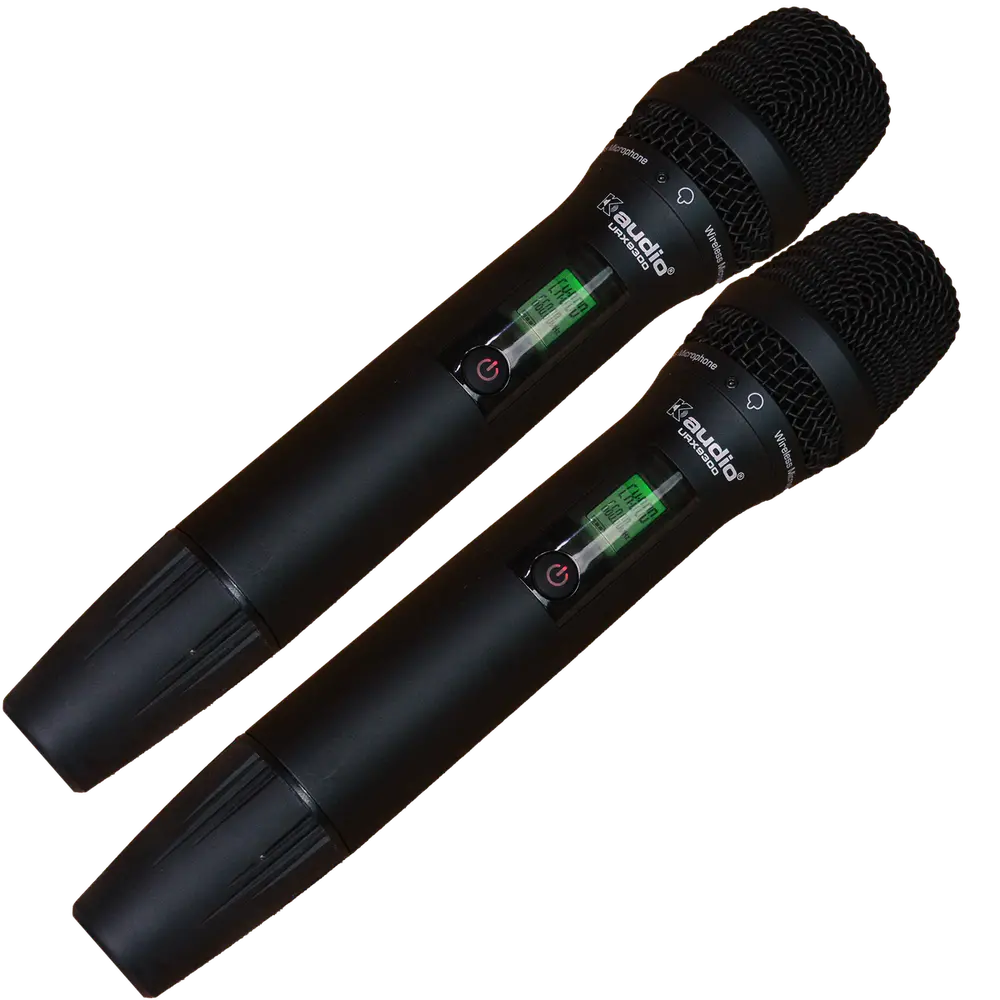
Wireless microphones fail in public, which makes them the highest-stakes item in most systems. Nearly every failure traces back to frequency planning, antenna placement or battery discipline rather than the microphone itself.
Use UHF systems with selectable frequencies, coordinate channels rather than picking numbers at random, keep receiver antennas in line of sight, and treat batteries as consumables with a fresh set for every event.
Why UHF is the working standard
UHF penetrates obstacles better than VHF and has room for more simultaneous channels. Multi-channel UHF systems with selectable frequencies let you find clear space in a crowded RF environment.
Systems offering 100 selectable channels give you real flexibility when you move between venues with different local broadcast usage.
Running multiple channels without interference
Frequencies must be coordinated, not just set to different numbers. Intermodulation products from combinations of transmitters can land on a channel you are using.
Use the manufacturer's recommended channel groups. Scan the venue before the event, and keep a written list of assignments.
Antenna placement and line of sight
Keep receiver antennas in line of sight of the performers where possible. Bodies absorb RF, so a receiver behind a wall or a crowd will drop out.
Diversity receivers use two antennas to avoid nulls. Spread them apart rather than mounting them parallel and close together.
Handheld, headset or lapel
Handheld suits vocals and roaming presenters. Headset keeps a constant mouth distance and is ideal for fitness instructors and speakers who move a lot. Lapel is discreet but picks up clothing noise.
Whichever you choose, budget for spare batteries and treat them as consumables.
| Type | Best for | Typical channels | Notes |
|---|---|---|---|
| Handheld | Vocals, presenters, roaming | 1 to 8 | Most robust, easiest to pass around |
| Headset | Fitness, theatre, worship | 1 to 8 | Constant mouth distance, best gain before feedback |
| Lapel | Interviews, conferences | 1 to 8 | Discreet, prone to clothing noise |
| Multi-channel rack | Large productions | 8 to 12+ | Requires proper frequency coordination |
RF basics: what actually causes dropouts
Radio signal drops when the receiver cannot distinguish the transmitter from noise. That happens through distance, obstruction, interference from another transmitter, or antenna nulls.
Human bodies are largely water and absorb UHF effectively. A performer turning their back to the receiver can cost several dB of signal, which is enough to drop out at range.
Metal structures reflect RF and create standing waves. In a venue with lighting truss and steel, dropouts can occur at very specific positions on stage.
Frequency coordination in practice
Transmitters do not simply occupy their own frequency. Combinations generate intermodulation products at predictable mathematical relationships, and those products can land on a channel you are using.
Manufacturer channel groups are pre-calculated to avoid this. Using them is far more reliable than choosing frequencies that merely look different.
Scan the venue before every event in a new location. Local broadcast usage varies by region and changes over time.
Battery management and event discipline
Alkaline cells give predictable discharge and a usable low-battery warning. Many rechargeables sit at lower nominal voltage, so the transmitter's battery meter can read incorrectly.
Fit fresh batteries for every significant event. The cost of a battery is trivial against the cost of a failure during a service or performance.
Keep a labelled spare set at the mixing position, along with a spare transmitter if the event is critical.