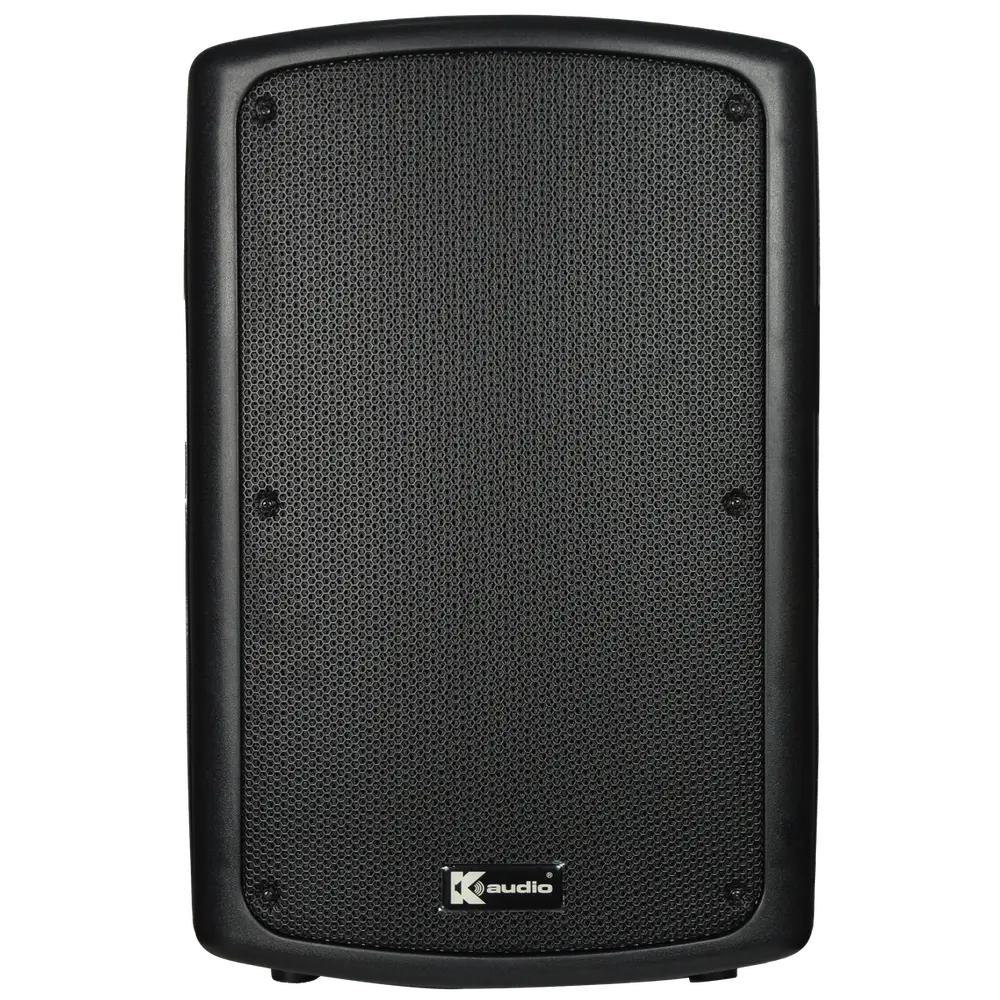
Worship spaces are among the hardest rooms to get right. They are usually reverberant, often architecturally protected, and they have to serve both spoken word and music. Intelligibility has to come first.
In worship spaces, intelligibility beats loudness. Use tightly directional speakers aimed at the congregation, keep microphones close to the talker, and treat the balcony and side aisles as separate zones with their own level control.
Start with the room, not the equipment
Hard parallel surfaces, stone, glass and high ceilings all extend reverberation time. Long reverb smears consonants, and consonants carry intelligibility. No speaker fixes a room problem; the right speaker just stops making it worse.
The practical response is directivity. Choose cabinets with controlled coverage and aim them at people, not walls. Every reflection you avoid is clarity you keep.
Speaker placement that works
Mount mains high enough to clear sightlines and angle them down into the seating. In deep naves, a distributed system with delay speakers usually beats trying to cover everything from the front.
For balconies, treat them as a separate zone. A balcony almost always needs its own speaker and its own level control.
Microphones for worship
Lapel and headset microphones give the pastor freedom to move and keep a consistent distance from the mouth, which stabilises level. Handheld dynamics suit readings and vocals.
Wireless UHF systems with sufficient channel count matter when several people speak in one service. Plan frequencies in advance.
Mixer sizing and volunteer operation
Worship systems are usually run by volunteers, so simplicity beats capability. Label everything, save a default scene, and limit what can be changed accidentally.
A powered mixer often suits smaller congregations. Larger churches with a music team benefit from a full console and separate amplification.
| Congregation | Speaker approach | Mixer | Wireless channels |
|---|---|---|---|
| Up to 100 | Single pair, 10 or 12-inch | Powered, 8 channel | 1 to 2 |
| 100 to 300 | Pair plus delay or distributed | Powered, 12 to 16 channel | 2 to 4 |
| 300 to 700 | Distributed or small array | Console plus separates | 4 to 8 |
| 700+ | Line array, multi-zone | Digital console | 8+ |
Understanding reverberation time and what it does to speech
Reverberation time is how long sound takes to decay by 60 dB. Below about 1.2 seconds, speech stays clear. Above 2 seconds, consonants overlap and intelligibility collapses regardless of how loud the system is.
Stone, plaster, glass and hard pews all reflect. Carpet, soft furnishings and people absorb. A full church can have noticeably shorter reverberation than an empty one, which is why systems tuned in an empty building often sound wrong on Sunday.
You cannot fix reverberation with volume. Turning up increases both the direct sound and the reverberant field, so the ratio between them stays the same. Only directivity and speaker placement change that ratio.
Delay speakers and why timing matters
In long naves, speakers partway down the room let you keep level even without overpowering the front. Those speakers must be delayed so their sound arrives just after the sound from the front.
Set delay to the acoustic travel time between the main speakers and the delay position, then add 10 to 15 milliseconds. That keeps the perceived source at the front, which is where the person speaking actually is.
Without correct delay, listeners hear the nearer speaker first and the sound appears to come from the side of the room, which is disorienting.
Hearing loops and accessibility
Many jurisdictions require an assistive listening system in places of worship. An induction loop feeds a signal directly to hearing aids set to the T position.
The loop takes a feed from the mixer, so plan an output for it during system design rather than retrofitting later.
Test the loop with an actual field-strength meter. A loop that is installed but out of specification helps nobody.
Training volunteers and locking down the system
Document a default state: gain settings, fader positions, EQ. Photograph the desk in that state and tape it inside the lid.
Restrict what can be changed. Many powered mixers allow you to physically cover or lock controls. The fewer things a volunteer can accidentally alter, the more reliable the system becomes.
Run a short training session with the people who will actually operate it, not just the person who commissioned it.