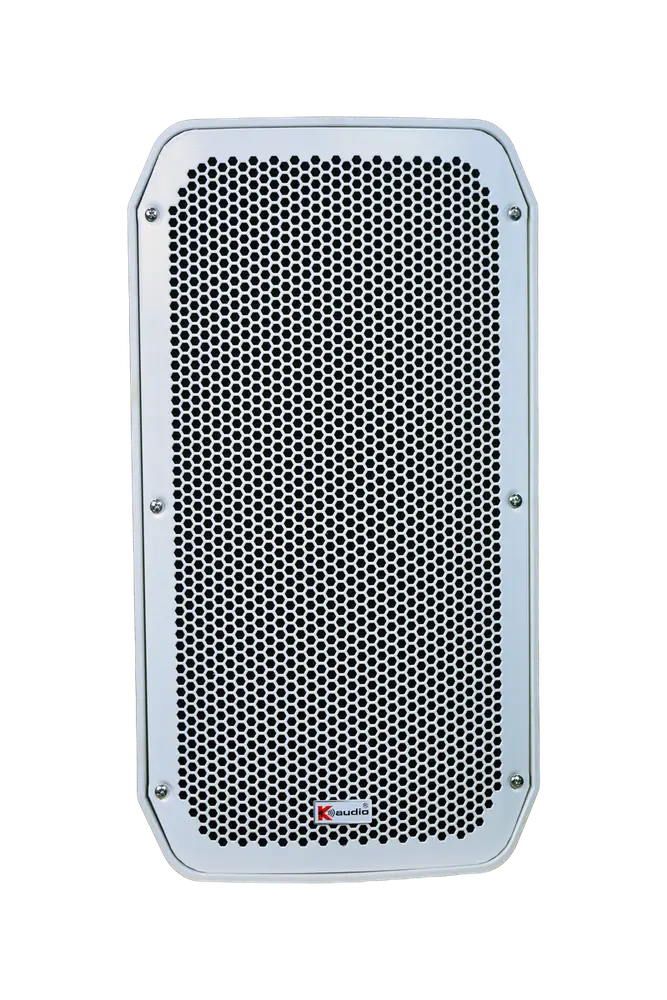
School halls are multi-purpose by definition. The same room hosts assemblies on Monday, a drama production on Wednesday and a sports event on Friday. The audio has to survive all three and be operable by staff who are not audio engineers.
Specify for the worst case, which is usually a sports event or a full assembly. Distribute speakers rather than relying on one loud pair, mount everything out of reach, and preset the system so staff can use it without training.
Coverage in a hard, wide room
School halls are typically wide, low-ceilinged and acoustically hard. Distributed speakers usually beat a single loud pair, because you keep levels even without pushing the front rows.
Wall-mount and ceiling speakers work well for speech-dominant use. Add portable cabinets on poles when the hall is used for performances.
Durability and tamper resistance
Equipment in schools takes abuse. Choose fixed installations where possible, use lockable racks and put the mixer somewhere controlled.
Wall-mounted speakers well above head height survive far longer than anything on a stand in a corridor.
Keep operation genuinely simple
If a teacher cannot use it in thirty seconds without training, it will not get used. Preset levels, label inputs clearly and hide anything that should not be adjusted.
A powered mixer with saved settings and a couple of clearly-marked microphone inputs covers most day-to-day needs.
Microphones for assemblies and performance
A handheld wireless for the head teacher, a headset for drama and a couple of wired mics for lecterns covers the majority of school use.
For performances, consider floor mics for choir and additional wireless channels for leads.
| Hall capacity | Speaker approach | Wireless mics | Approx power |
|---|---|---|---|
| Up to 150 | Single pair on brackets | 1 handheld | 300 to 500 W |
| 150 to 350 | Pair plus delays, or 4 distributed | 1 handheld, 1 headset | 600 to 1000 W |
| 350 to 600 | Distributed 6 to 8 cabinets | 2 handheld, 2 headset | 1000 to 1600 W |
Designing for multiple uses in one room
Assemblies need speech clarity. Drama needs coverage of the stage and radio microphone capacity. Sports needs high level over crowd noise. Discos need low frequency extension.
Rather than compromising on one system, design the fixed installation for speech and provide inputs for temporary equipment when higher output is needed.
A patch panel with clearly labelled inputs at the stage and at the rear of the hall makes temporary setups fast and prevents cables being run across floors.
Cable management and safety
Trailing cables in a school hall are a genuine hazard. Install fixed cabling in trunking to speaker positions and to a stage patch point.
Wall-mounted input plates cost little and remove the need to run microphone cable from the mixer to the stage every time.
Where portable equipment is unavoidable, use cable ramps and brief staff on routing.
Budgeting and phasing the installation
Schools rarely fund everything at once. Specify the full system, then phase it: fixed speakers and amplification first, wireless microphones second, additional zones later.
Choose an amplifier with spare channels so later phases do not require replacing what is already installed.
Document the design so a different contractor can complete a later phase without redesigning from scratch.