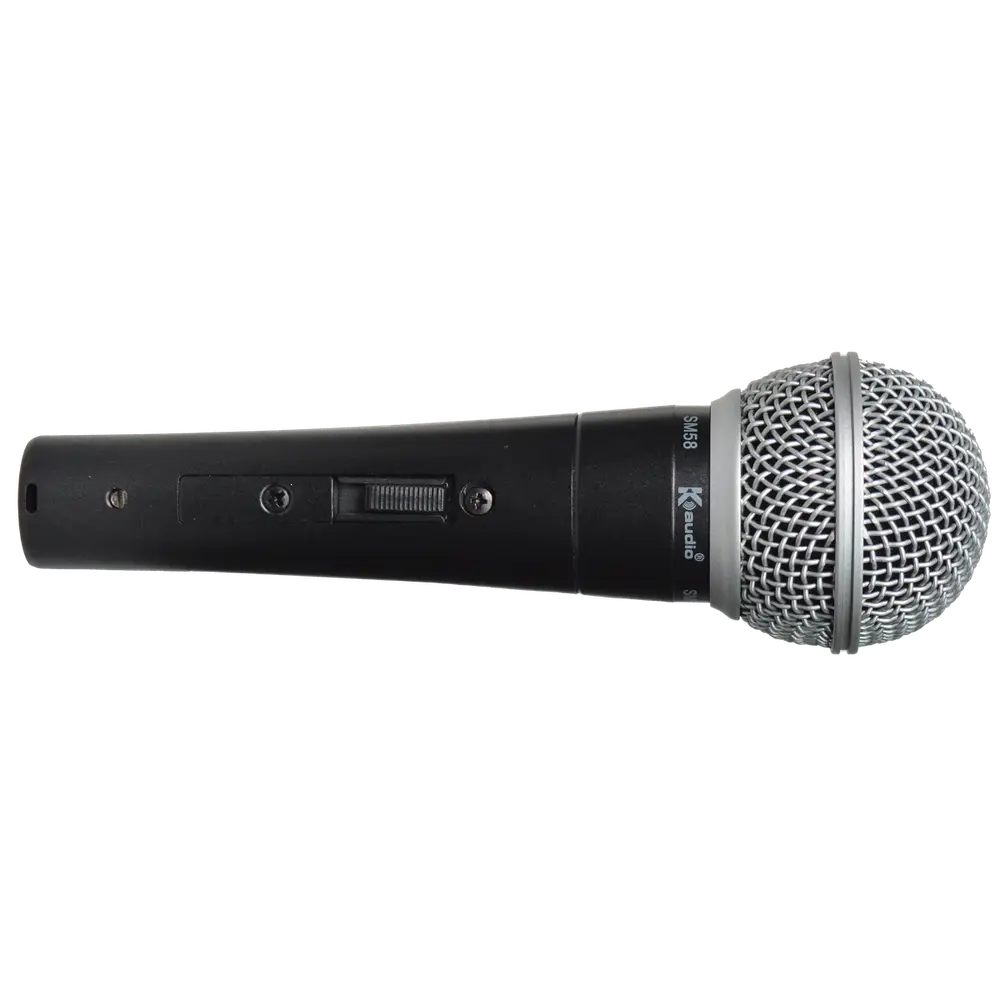
The two dominant microphone types work on completely different principles, and that difference determines where each one belongs. It is less about which sounds better and more about which survives the job you are asking it to do.
Use dynamic microphones for live vocals, loud sources and anywhere durability and feedback resistance matter. Use condensers where detail and extended high frequency response matter more, such as choirs, acoustic instruments and controlled rooms. Condensers need phantom power; dynamics do not.
| Property | Dynamic | Condenser |
|---|---|---|
| Power required | None | 48V phantom |
| Sensitivity | Lower | Higher |
| Max sound level | Very high | High, varies |
| High frequency detail | Good | Excellent |
| Feedback resistance | Better | Requires more care |
| Durability | Excellent | More fragile |
| Typical use | Live vocals, drums, guitar | Choir, overheads, speech in quiet rooms |
How each type actually works
A dynamic microphone uses a diaphragm attached to a coil suspended in a magnetic field. Sound moves the diaphragm, the coil moves, and current is generated. It is the same principle as a loudspeaker in reverse, which is why dynamics need no external power.
A condenser uses a thin charged diaphragm close to a fixed backplate, forming a capacitor. Sound changes the spacing and therefore the capacitance, which produces the signal. Maintaining that charge and driving the output requires power, supplied as 48 volt phantom power.
The condenser diaphragm is far lighter, which is why it responds faster and captures more high-frequency detail. It is also why it is more fragile.
Where dynamics are the correct choice
Live vocals, particularly handheld. Dynamics tolerate high sound pressure, resist moisture from close vocal use, and survive being dropped.
Loud sources such as guitar cabinets and drums, where a condenser might overload.
Any situation with significant stage volume, because lower sensitivity means less room and monitor spill, which translates directly into more gain before feedback.
Where condensers earn their place
Choirs, orchestras and ensembles where the microphone is at distance and needs sensitivity to capture the source.
Acoustic instruments and anything where high-frequency detail carries the character of the sound.
Fixed installations such as lecterns and conference tables, where the microphone is not handled and the room is reasonably controlled.
Handling noise, wind and practical protection
Dynamics generally exhibit less handling noise, which matters for anything passed between speakers. Internal shock mounting varies between models.
Condensers used outdoors or near air conditioning need windshields. Their sensitivity to low-frequency air movement is far greater.
Condensers also dislike humidity. In a fitness studio or outdoors in damp conditions, a dynamic will simply be more reliable.